
Your itinerary says Kyoto. Your ship docks in Osaka or Kobe. By the time you travel to Kyoto and back, a short port day can feel very short indeed.
That is why we look past the itinerary title before we look at the fare. We have cruised Japan on a port-intensive small ship, sailed Diamond Princess during Golden Week, and arrived in Yokohama on a transpacific. Some of the most useful lessons came from discovering that a familiar city name on a cruise listing does not tell you where your day will actually begin.
Key Takeaways
- Confirm the exact pier and travel time behind every familiar port name.
- Compare actual Japan stops, port hours, overnights, and sea days before comparing fares.
- Add land time when possible, and choose excursions separately for each port.
- Prioritize the itinerary over a cabin upgrade on a port-intensive sailing.
Table of Contents
- First, find out where the ship really docks
- Give any Japan itinerary a 60-second test
- Choose your season with your eyes open
- Add land time, and do not overlook the small ports
- Plan each port on its own terms
- Which Japan cruise style fits you?
- Spend on the itinerary before you spend on the cabin
- Before you pay a deposit, check the trip you are actually buying
First, find out where the ship really docks
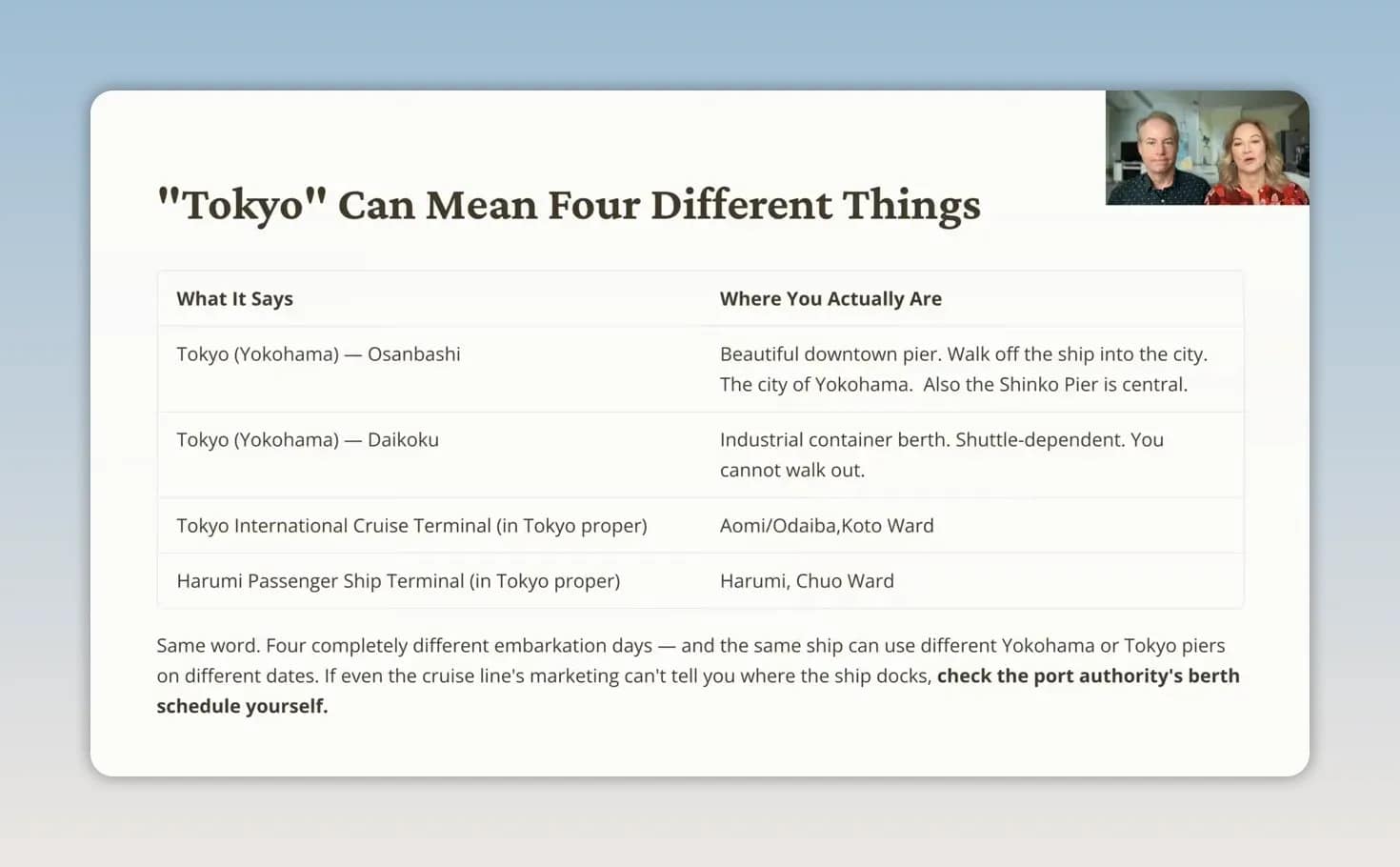
“Tokyo” may mean Tokyo or Yokohama
A sailing advertised as departing from Tokyo may use a terminal in Tokyo itself or a pier in Yokohama, roughly an hour away. Even within Yokohama, the specific pier matters. On one trip, we could walk off into the city. On another, our larger ship docked on the other side of the bridge and we needed a transfer.
Yokohama is a terrific place to explore in its own right, and trains make Tokyo accessible. It is simply not the same as stepping off the ship in Tokyo. Before booking flights, hotels, or plans for embarkation day, check the exact terminal and pier, not just the city printed on the itinerary.
There is no cruise terminal in Kyoto
Kyoto is understandably high on many Japan wish lists, but a ship calling at “Kyoto” will generally dock in Osaka or Kobe. That means your available time in Kyoto depends on your arrival point, the trip inland, and the ship’s departure time.
Our favorite solution is an overnight in Osaka or Kobe. On our planned Celebrity Millennium trip, that gives us room for a full Kyoto day, including time there after dark, without rushing back for an early departure. We can return to the ship late and use the following day for an easier look around Osaka. Kyoto at night feels like a different experience, and an overnight makes it practical.
Give any Japan itinerary a 60-second test
We sailed an Azamara Japan Intensive with two weeks of stops in different Japanese cities and towns. Other cruises marketed as Japan sailings may call at only two or three Japanese ports. Neither is automatically a bad trip, but they serve very different purposes.
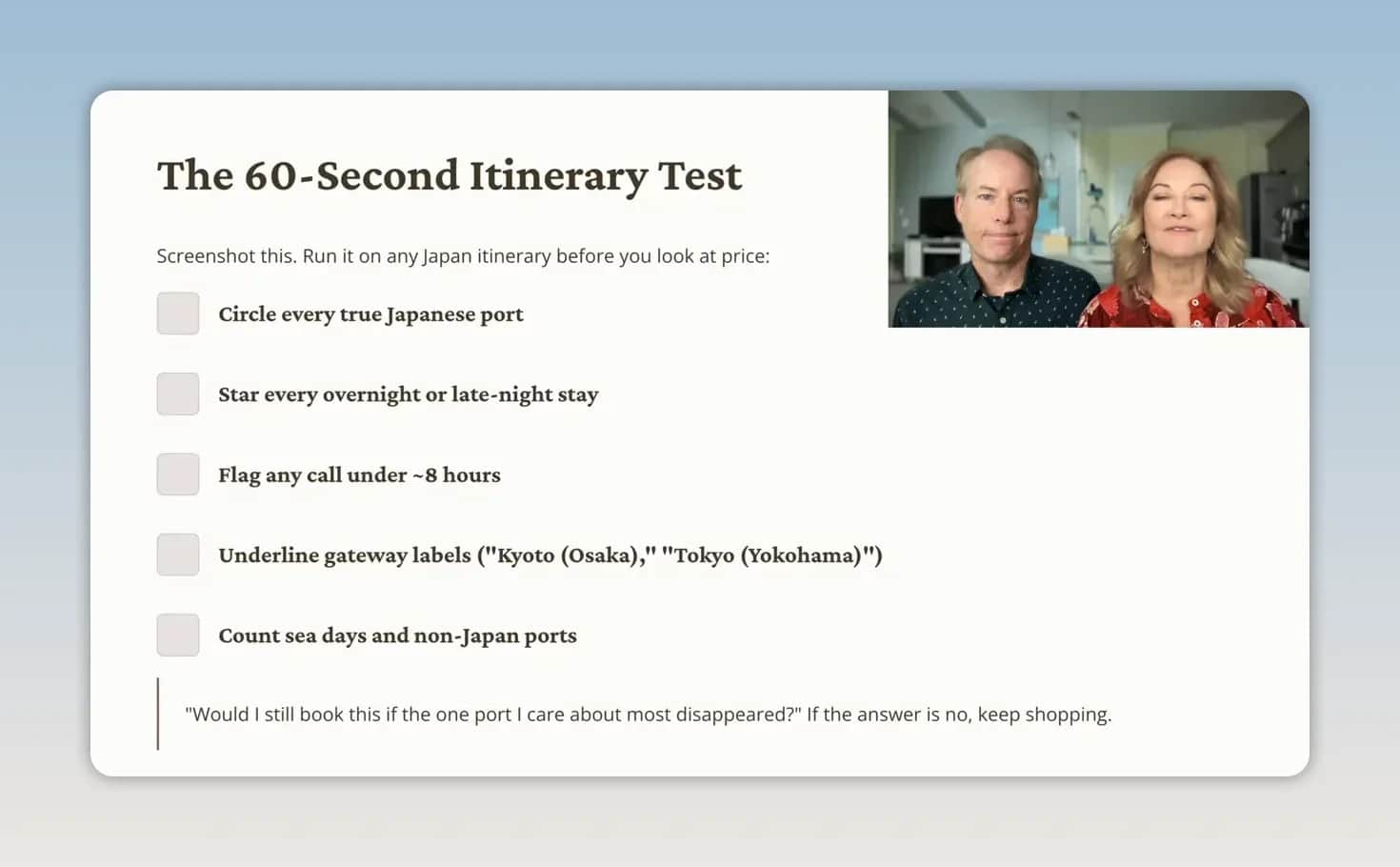
Before comparing prices, open the day-by-day schedule and do this:
- Circle every actual port in Japan. Count the stops, not the destinations implied by the cruise title.
- Star every overnight and late departure. Extra hours can matter more than an additional short call.
- Check each port’s arrival and departure times. A four or five hour stop may leave little time after transfers.
- Count sea days and ports outside Japan. Decide whether that balance is what you want.
- Test your must-see stops. If one port were canceled or replaced, would you still want the cruise?
That last question is not theoretical for us. We have had two stops missed or changed. A cruise is a much safer choice when several ports excite you, rather than one stop carrying the entire trip.
Why South Korea or Taiwan appears on the itinerary
Many foreign-flagged Japan cruises include a call in South Korea or Taiwan because of maritime rules affecting their routes. We have enjoyed those stops. They add another country and a welcome change of pace.
Just account for what happens afterward. Returning to Japan means clearing immigration again, which can take an hour or two. On a short port day, that wait can change what is realistic ashore.
Beware the “Asia cruise” trap
A Tokyo to Singapore sailing, or a route involving Hong Kong, can be wonderful. We like sea days ourselves. But a cruise sold alongside Japan itineraries may devote relatively little time to Japan and a great deal of time to sailing elsewhere.
If you want a broader Asia trip, that may be exactly right. You could also add time in Japan before or after the voyage. If your goal is to explore Japanese ports, run the 60-second test before assuming the itinerary delivers that.
Choose your season with your eyes open
Cherry blossom season is beautiful, not guaranteed
Cherry blossoms are worth seeing, but their timing is brief and changes with the weather. Booking a spring cruise does not guarantee blooms at every stop, or even at the stop you care about most.
The bloom progresses across Japan over several weeks, so an itinerary covering different regions improves your chances of finding blossoms somewhere. On our Azamara cruise, Tokyo had only a few when we arrived, while later stops farther south delivered the display we had hoped for. We also used a Sakura forecast app to check conditions by city as the trip unfolded.
Expect popular blossom-season sailings to cost more and book up earlier. We would choose one only if the cruise still appeals without a promise of peak blossoms.
Golden Week can be special and very busy
We sailed Diamond Princess during Golden Week, Japan’s major holiday period, and loved the celebratory atmosphere aboard. Many of our fellow passengers were Japanese, which made that particular sailing feel especially memorable.
Ashore, the trade-off is crowds and demand. Hotels can be more expensive, attractions busier, and transportation harder to secure. We once had a hotel booked in Hiroshima during a holiday and then discovered we could not get the train we needed. If your cruise overlaps Golden Week, plan the land portion and important transfers early.
Match the weather to the kind of trip you enjoy
Japan in summer can be surprisingly hot and humid, especially when you are spending long days exploring ports. We have also enjoyed Japan in winter, but it is a completely different experience. Think about how much walking you want to do, what you hope to see, and how comfortable you will be in the conditions for your dates.
Add land time, and do not overlook the small ports
For us, a Japan cruise is even better with a few days on land before or after. Arriving early gives you time to recover from the flight rather than beginning a busy port itinerary while jet-lagged. Staying afterward means you can enjoy the end of the cruise without immediately facing a long international flight.
Japan’s trains also make it possible to spend more time in Tokyo, Osaka, or Kyoto, or return to a place that a short port call could not do justice. You can find practical transportation information through the Japan National Tourism Organization’s travel planning resources. Once your cruise is booked, our post-booking cruise checklist can help you organize flights, hotels, reservations, and the rest of the details.
And while the big names get most of the attention, do not dismiss the smaller calls. Some of our favorite days were in places that see fewer cruise visitors, where the welcome felt particularly warm. Aomori, home of the Fuji apple, stands out, as do Hakodate, Takamatsu, Kanazawa, Akita, and Niigata. A strong Japan itinerary need not be a list of famous cities alone.
Plan each port on its own terms
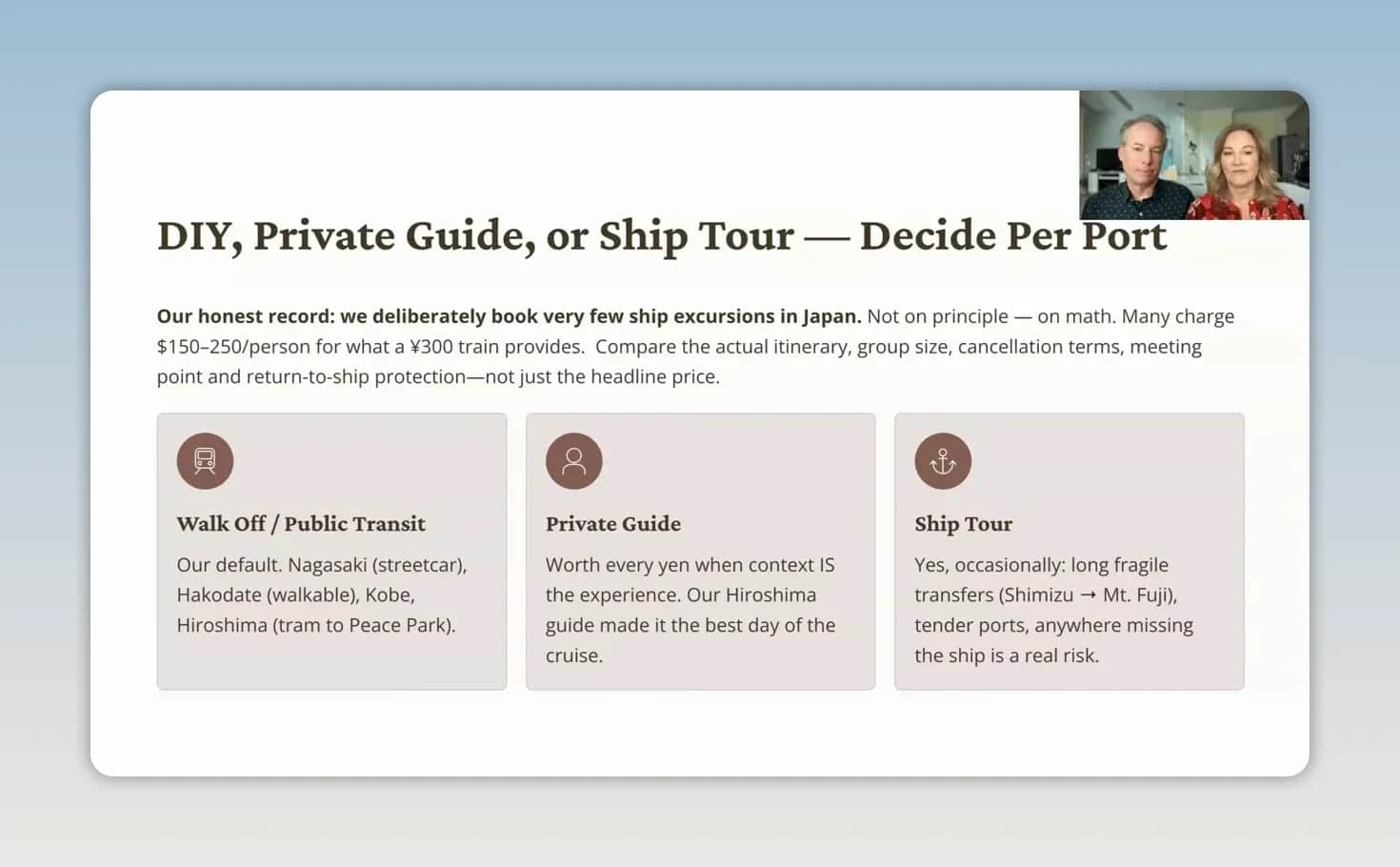
We do not book a ship excursion in every Japanese port. Often we can walk off, take a train or bus, or use a taxi and explore independently. It can cost less and give us more freedom to follow an interesting street, shop, or restaurant.
Other days call for more help. In Hiroshima, we wanted to learn as much as we could about what we were seeing, and a guide made a real difference. A small private food tour can also be a lovely addition. Decide port by port whether you want the freedom of doing it yourself, the insight of a guide, or the simplicity of a ship tour. Our shore excursion planning guide goes further into making that choice.
Getting around has generally felt easier than we expected. People have been helpful even when we did not share much language, and ticket or restaurant-ordering machines often offer an English option. Japan is also a no-tipping country, removing one small thing to think about during the day.
Most importantly, do not eat every meal on the ship. Trying a ramen shop can be one of the best parts of a port visit, and eating locally has often been surprisingly affordable for us. Look up a city’s specialty before you arrive. Kobe is an obvious place to consider a beef lunch, while another stop might be the place to seek out its particular style of udon.
Which Japan cruise style fits you?
There is no single best cruise line for Japan. Princess, Celebrity, Azamara, Holland America, Royal Caribbean, Norwegian Cruise Line, and several luxury lines all offer possibilities, but their ships, seasons, and routes vary. Even two ships from the same line can deliver very different trips.
For a first Japan cruise: Princess
Princess is a strong place to start if you want a range of itinerary lengths and reasonable pricing. We sailed Diamond Princess in Japan and appreciated how localized the onboard experience felt. Sapphire Princess is another ship to consider. Both were built in Japan, and Princess’s Medallion technology is a convenient touch. We particularly like the way the cabin door recognizes us as we approach.
For a closer look at the ship experience, see our Diamond Princess Japan review.
For a premium mid-size ship: Celebrity
Celebrity Millennium offers Japan-focused itineraries on a mid-size ship. Although it is an older vessel, it has been updated, and the familiar Celebrity combination of food and service makes it appealing. Depending on the fare, there may be options to bundle items such as drinks and Wi-Fi.
Celebrity Solstice adds another set of regional possibilities for 2028, including sailings that reach beyond Japan. That distinction matters: choose Millennium or Solstice for the specific itinerary you want, not simply because both carry the Celebrity name.
For late nights and a smaller ship: Azamara
Our Azamara Japan Intensive was exactly that: many ports, a ship carrying fewer than 700 guests, and the kind of late stays and overnights that let us experience Japan after dark. The fare is typically higher than on a larger ship, but there are more inclusions.
One of our favorite resources aboard was a Japanese port specialist. We could ask what to see or where to find a local dish, and often leave that conversation with a complete plan for the next day. Our Azamara Journey Japan Intensive review has more on that sailing.
For sea days and potential value: a transpacific
A transpacific can offer attractive pricing because it includes many days at sea. Sail toward Japan and you may arrive without the jet lag of a flight across the Pacific. Sail home afterward and you can replace one long flight with time aboard.
The catch is obvious but important: a crossing is not a port-intensive Japan cruise. Pair it with land travel or another sailing if seeing many parts of Japan is the goal. Travelers with much more time can also consider longer grand voyages and luxury itineraries from lines such as Oceania, Viking, Silversea, and Azamara.
Spend on the itinerary before you spend on the cabin
On a busy Japan sailing, we are often out from morning until evening. A comfortable stateroom with enough space may serve us better than paying substantially more for a suite we barely use. We would put the itinerary, port hours, and extra land days first.
A transpacific is the exception worth thinking through. With many sea days, you spend much more time aboard, so a cabin upgrade may add more to the experience.
Before you pay a deposit, check the trip you are actually buying
- Do I know the exact embarkation and disembarkation piers?
- Have I counted the actual Japanese ports and their hours?
- Are there overnights or late stays where I most want extra time?
- Have I allowed for transfers to places such as Tokyo or Kyoto?
- Do I want the number of sea days and non-Japan stops on this route?
- Have I accounted for immigration when the ship returns to Japan?
- Does the season suit me, even if blossoms or weather do not cooperate?
- Would I still enjoy this cruise if a favorite port were missed?
- Have I compared the value of land days, excursions, and cabin upgrades?
If those answers line up with the trip you have been imagining, you are in a much better position to book confidently. If they do not, keep looking. The right Japan cruise is not necessarily the one with the best-looking title or the lowest fare. It is the one that gives you enough time in the places you actually want to experience.
Would You Like a Free, Personalized Quote On Your Next Ocean or River Cruise?
We can share special perks, amenities, upgrades and onboard bonus credit
