
After seven transatlantic cruises and helping book dozens more, one thing is clear: a lot of people misunderstand what this kind of cruise actually is. What are the most common transatlantic cruise booking mistakes?
They shop by price per day. They focus too much on ports. They book a cabin they could tolerate for seven nights, not one they’d be happy living in for nearly two weeks. And then they’re surprised when the experience feels different from a typical Caribbean sailing.
A transatlantic can be one of the best values in cruising and one of the most relaxing, memorable trips you’ll ever take. But only if you choose it the right way.
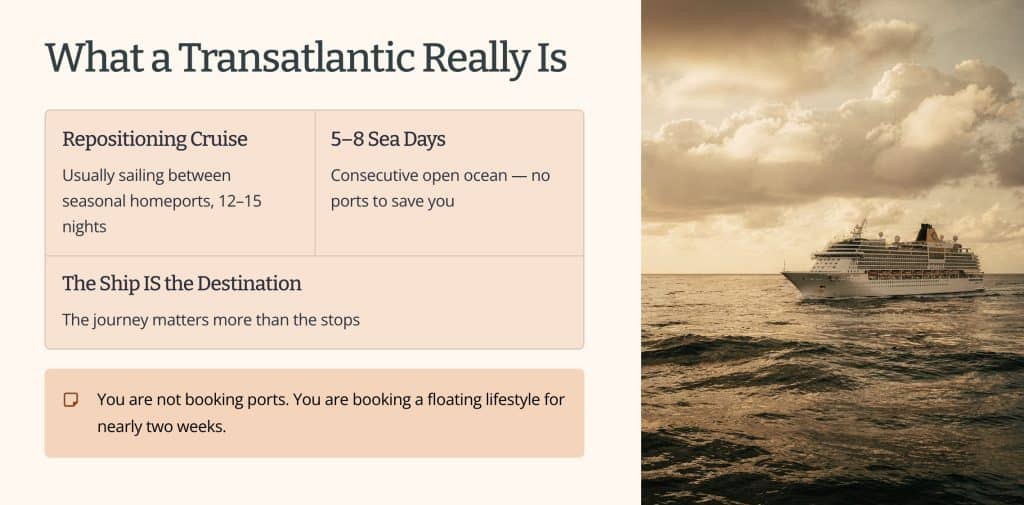
The biggest mindset shift is this: on a transatlantic, the ship is the destination.
These sailings are usually repositioning cruises. The cruise line is moving a ship from one region to another for the season, often between North America and Europe. That typically means a voyage of around 12 to 15 nights, with five to eight sea days and only a handful of ports.
The ports can absolutely be a nice bonus. We’ve had some exciting stops on these sailings. But that is not the reason to book one. If you choose a transatlantic based mostly on itinerary, there’s a good chance you’re going to be disappointed. If you choose it based on the ship, the stateroom, the onboard lifestyle, and the total trip value, you’re much more likely to love it.
Book the ship you actually want to live on
The easiest way to think about a transatlantic is this: if you were going to live in a hotel for two weeks, what kind of hotel would you choose?
That is basically the question you should ask when picking your ship.
You are not choosing transportation with a few perks attached. You are choosing your temporary life at sea.
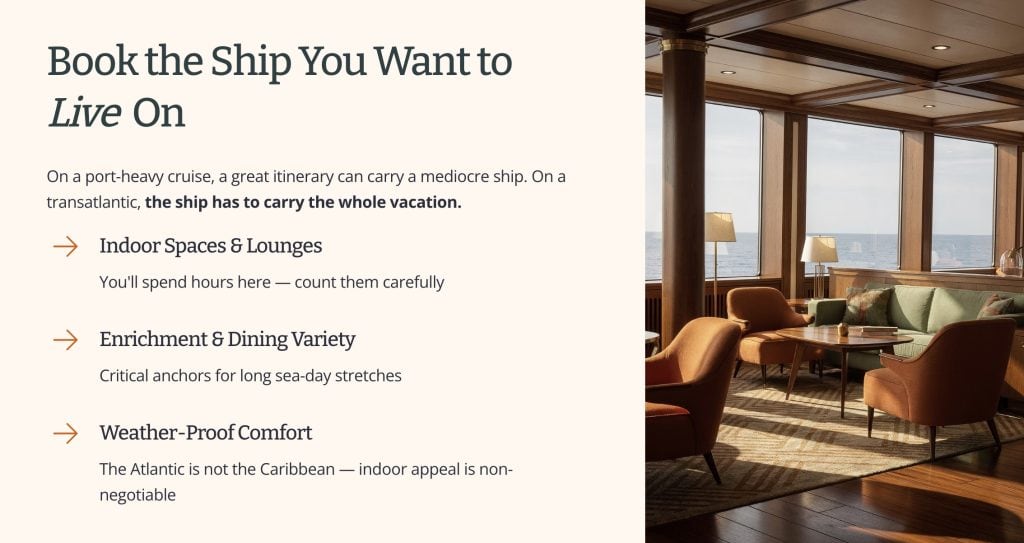
Look hard at indoor space
This matters much more than people expect.
On a Caribbean cruise, you can often count on spending big chunks of time outdoors by the pool or on open decks. On a transatlantic, weather can be incredible, but it can also be cloudy, windy, cool, or rough. We’ve had crossings with beautiful flat seas, and we’ve also had crossings where it felt like most of the ship’s outdoor space might as well not exist for several days.
That means you need a ship with plenty of comfortable indoor lounges, public spaces, and weatherproof hangout areas. If everyone is inside for multiple sea days, the ship needs to handle that well.
Dining variety matters more than usual
For a weeklong cruise, you can tolerate limited food variety. For two weeks, it starts to matter a lot.
If your ship mostly gives you one main dining room and one buffet, that can get repetitive fast. We generally prefer medium-size or larger ships for transatlantics because they tend to offer more restaurant choice, but smaller ships can work too if they’ve built in enough variety.
We’ve had great crossings on larger ships like Royal Caribbean’s Odyssey of the Seas, where there were lots of dining options, and also on smaller ships like Viking Ocean, where the line still gave enough distinct dining experiences and specialty venues to keep things interesting.
Think about the vibe you want for 12 to 15 nights
This is where a lot of people miss the mark.
Some travelers want quiet, calm, and enrichment. Others want something social, lively, and more energetic. Those are not small differences on a transatlantic. They can completely change which ship and cruise line make sense for you.
If you want help sorting through that, this guide on how to choose a cruise is a useful starting point because the right line matters even more on a crossing with so many sea days.
Bigger ships can help if you’re worried about motion
Generally speaking, larger ships often handle rougher seas better than smaller ones. That doesn’t mean a big ship eliminates motion, because the Atlantic is still the Atlantic, but it can make the experience more comfortable for some people.
The cheapest fare is often not the cheapest cruise
Yes, there are amazing transatlantic deals out there. Some of them look almost absurdly cheap at first glance.
But this is where people get burned.
That lowest advertised fare may not include much of anything. On a crossing, extras add up because you’re not paying them for five nights. You’re paying them for two weeks.
Pay close attention to what is and isn’t included:
- Wi-Fi
- Gratuities
- Drink packages
- Specialty dining
- Other onboard perks
Sometimes a cruise with a higher sticker price ends up being the better overall deal because it includes so much more. This is especially true on premium and luxury lines, where the daily rate may initially seem high but the total value is stronger once you account for what would be extra elsewhere.
If you’re pricing out options, compare the real bottom-line trip cost, not just the lowest number on the search results page.
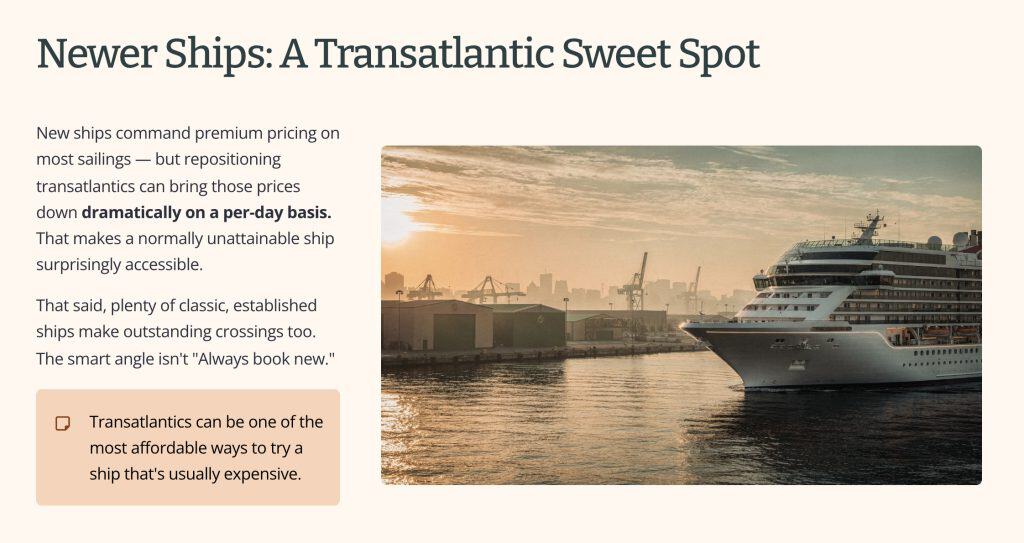
One of our favorite strategies: book newer ships on repositioning sailings
A newer ship on a transatlantic can be an outstanding value.
This is one of the strategies we personally use because repositioning sailings often price much lower than those same ships do in their peak seasonal markets.
For example, we booked Royal Caribbean’s Legend of the Seas for a fall crossing and got a much better nightly rate than that ship will typically command in Europe or the Caribbean. We’ve also booked newer luxury ships on transatlantic sailings at discounts that were dramatically lower than their normal pricing.
That’s one reason repositioning cruises can be such a sweet spot. You can sometimes experience a ship that would normally be out of budget on a regular itinerary.
For travelers looking at premium and luxury options specifically, this deeper look at luxury transatlantic repositioning cruises shows why these crossings can make five-star cruising much more affordable.
Eastbound vs. westbound: they are not the same experience
This is one of the most overlooked parts of booking a transatlantic.
Eastbound crossings
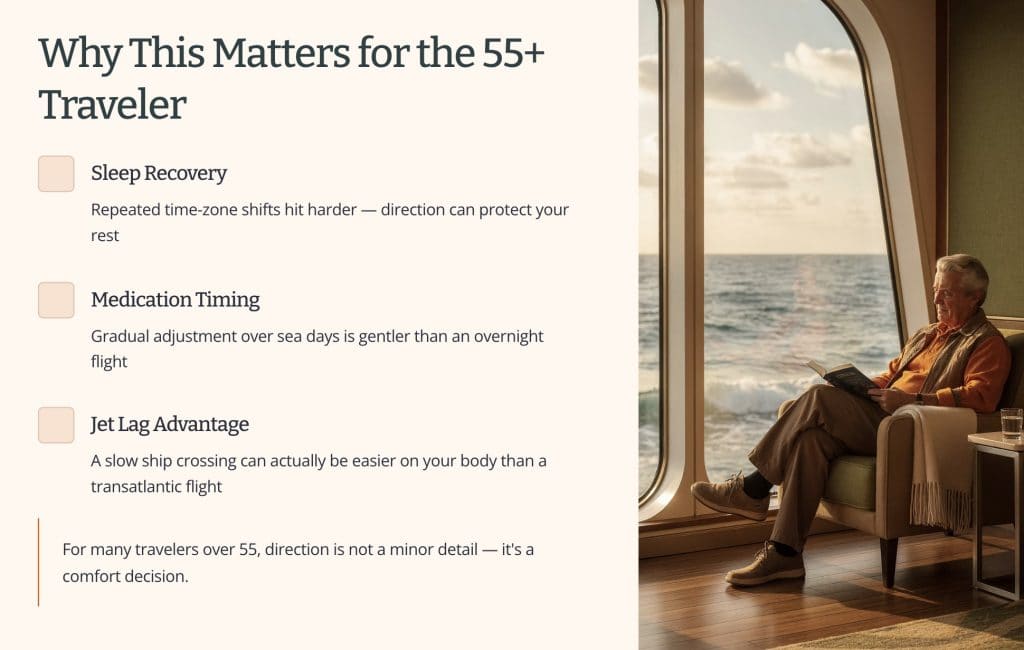
If you sail from North America to Europe, you usually lose an hour multiple nights along the way. That sounds annoying, and yes, westbound is more pleasant in that one narrow sense because you gain an hour instead.
But eastbound has a huge advantage: you gradually adjust to European time.
By the time you arrive, your body is already synced much more naturally than it would be after an overnight flight. For many travelers, especially those who don’t bounce back from jet lag as easily as they used to, this is a major benefit.
You get to Europe rested, adjusted, and ready to enjoy it.
Westbound crossings
Westbound is a treat in a different way. Picking up an extra hour at night feels great. And many westbound itineraries start with a string of European port days before the full crossing begins.
That creates a nice rhythm: active sightseeing first, then several restful sea days on the way back to the U.S.
We love that pattern because it feels like two vacations in one. You get the energy of a Europe cruise, then the deep exhale of a long ocean crossing.
Our advice is simple: try both directions over time. They each have their own appeal.
Sea day survival is mostly about pacing yourself
Some people worry they’ll get bored on five, six, or seven sea days in a row. That can happen, but usually it’s because they approached the cruise like a short sailing and burned through everything too fast.
There’s a very real mid-crossing slump that can show up. At the beginning, everything feels exciting and new. Then somewhere in the middle, the novelty fades and you suddenly think, wow, we still have a ways to go.
That feeling is normal. It’s mostly psychological.
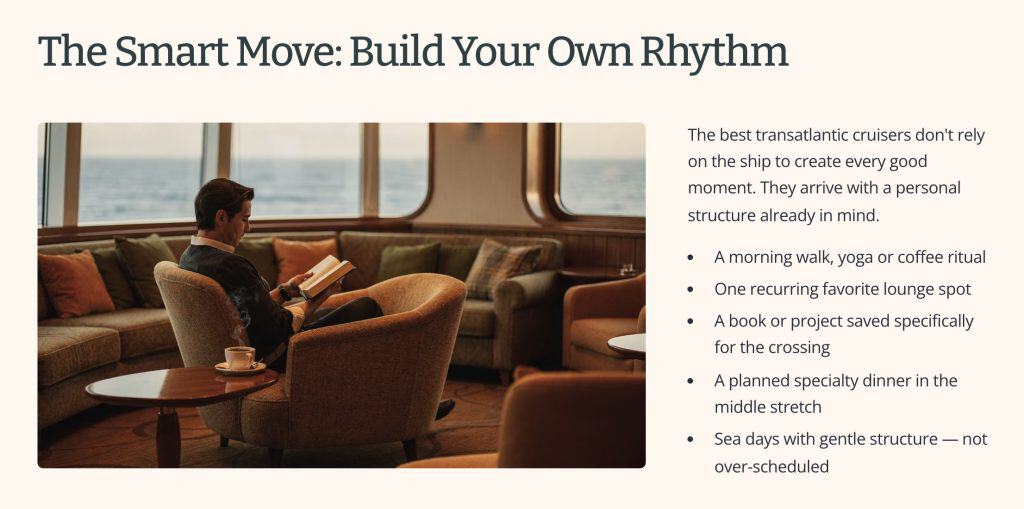
The best way to handle it is to build a rhythm and leave yourself things to anticipate.
Don’t front-load the whole cruise
On a seven-night cruise, it makes sense to rush around trying to fit in every specialty restaurant, every show, and every experience early. On a transatlantic, that can backfire.
You do not need to go to the specialty restaurant on day two. Day twelve works just fine.
Spread things out:
- Reserve specialty dinners across the full sailing
- Try specialty lunches to break up sea days
- Save certain shows or activities for later in the voyage
- Leave a few things unscheduled so you still feel discovery along the way
Specialty lunches can be especially smart on longer sailings because they’re often priced better, and cruise lines are motivated to fill those venues over so many days.
Create your own onboard routine
This is where transatlantics become incredibly enjoyable.
You start building a life onboard. Maybe that means gym in the morning, coffee in a quiet lounge, trivia in the afternoon, then a show or music at night. Maybe it means reading, spa time, pool time when weather allows, or doing absolutely nothing for a while.
Whatever your natural vacation rhythm is, a transatlantic gives you room to settle into it.
We’ve even done sailings where a daily progressive trivia session became part of the routine with friends. Same time every day, same gathering point, and by the middle of the crossing it felt like a real tradition.
Take advantage of enrichment
One of the nicest surprises on many transatlantic cruises is how much effort cruise lines put into programming.
Because there are so many sea days, they usually do more than they would on a standard seven-night itinerary. That can include:
- Guest speakers
- Destination lectures
- Cooking classes
- Hands-on workshops
- Expanded live music offerings
- More varied entertainment schedules
Destination lectures are especially worth attending. They help build anticipation for the ports ahead and can make your arrival more meaningful because you already have some context.
If you’re the kind of traveler who likes learning while traveling, a transatlantic can be a very satisfying format.
Cabin choice matters more on a transatlantic than on many other cruises
This is not the sailing to casually grab any cheap cabin and assume it will be fine.
For an extended crossing, your cabin becomes much more important because you are truly living in it.
Prioritize location if you’re motion sensitive
If movement bothers you, aim for a cabin that is:
- Midship
- On a lower deck
That is usually the most stable part of the ship.
Think beyond just sleeping there
On a longer cruise, little things start to matter more:
- Storage space
- A usable desk
- A sofa or sitting area
- A balcony
If you normally book inside cabins and are perfectly happy there, great. But if there was ever a sailing to consider upgrading, this might be it.
A balcony can be especially valuable on a transatlantic. Even if you don’t use it constantly, having your own private outdoor space can make the cabin feel much more livable over 12 to 15 nights.
And if you have loyalty perks on a cruise line, this is a great time to use them. Extra access to lounges or private spaces can really help break up the routine.
Also be more careful than usual about cabin noise. A location you can tolerate for one week may feel much worse over two weeks. Avoid problematic spots such as cabins directly under busy public venues if you can help it.
If you want to get more strategic with deck plans and cabin placement, this guide on how to choose the perfect cruise cabin is especially relevant for long repositioning sailings.
What first-timers consistently underestimate
The Atlantic is not the Caribbean.
That sounds obvious, but people still book these crossings expecting the same weather, the same pool-deck energy, and the same overall feel they get on warm-weather island itineraries.
What’s different?
- The seas can be rougher
- The weather may be cooler
- The pace feels slower
- Five or six sea days in a row is a distinct experience
That slower rhythm is not a flaw. It’s part of the appeal. But it does mean you need to know yourself.
If you genuinely dislike downtime, if you always need to be off the ship exploring, or if you feel impatient when travel itself becomes the experience, a transatlantic may not be your best fit.
But if the idea of long sea days, little routines, good meals, a clean cabin, no unpacking and repacking, and a gradual reset sounds good to you, these cruises can be incredibly rewarding.
What transatlantic cruises cost
Pricing can be surprisingly reasonable, especially when compared with standard sailings on the same ships.
Based on the examples shared for 2027, there were options across a wide range of cruise lines, from budget-friendly choices like MSC up through Holland America, Princess, Royal Caribbean, Celebrity, Norwegian, Azamara, Viking Ocean, Oceania, and luxury lines like Silversea and Seabourn.
The key takeaway is not the exact number for each line. It’s this: transatlantic pricing often makes premium and even luxury cruising far more accessible than many people assume.
A luxury line at around $1,000 per day may sound expensive until you compare it with what a true five-star hotel costs on land, before meals, drinks, service, and transportation are added. On lines like Silversea and Seabourn, the included value can be substantial.
There can also be good opportunities for solo travelers. Transatlantic sailings sometimes offer reduced or even waived solo supplements, which can make these crossings particularly compelling for people traveling alone.
Practical advice, especially for 55+ cruisers
These are simple points, but they matter.
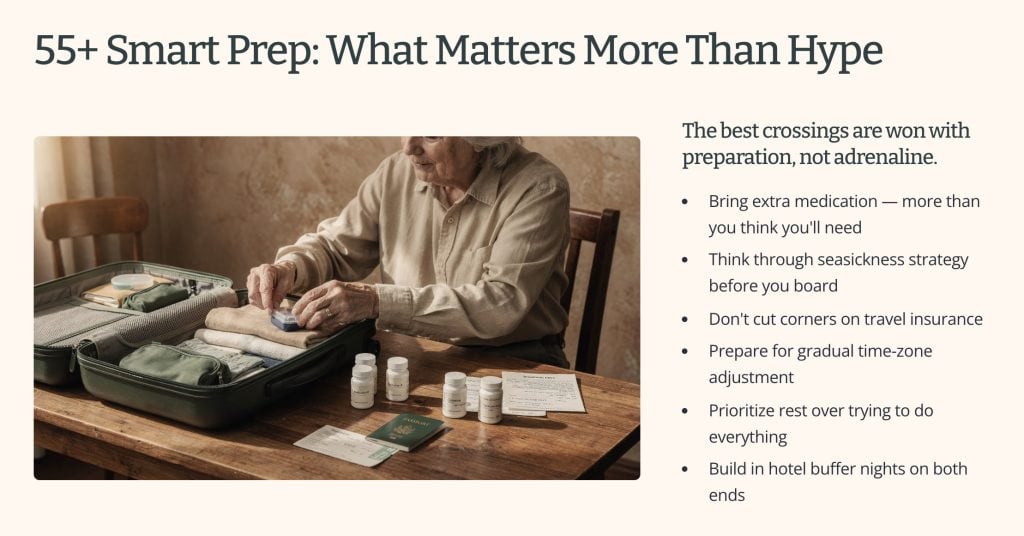
- Bring more medication than you think you’ll need. Delays happen. It’s just smart.
- Prepare for seasickness if there’s any chance you’re prone to it. The right cabin helps, but so do the remedies that work for you.
- Consider travel insurance. It can offer peace of mind on a longer international trip.
- Understand the time-zone shift. Especially on eastbound crossings, you’ll be adjusting gradually along the way.
- Build in a hotel buffer before the cruise. Arrive the day before, get a good night’s sleep, and start the trip without stress.
That pre-cruise hotel night is one of the easiest ways to make the entire trip smoother. Flying in on embarkation day is risky enough for a short cruise. For a transatlantic, where the whole trip is a bigger production, it’s really not worth the stress.
After the cruise, if you arrive in Europe, try not to turn right around and leave if you can help it. You already spent nearly two weeks getting there in the most relaxing way possible. If your schedule allows, stay a few extra days and turn it into a fuller adventure.
For general guidance on travel insurance and trip protection, resources like the NerdWallet travel insurance guide can help you think through what kinds of coverage may matter for a longer cruise trip.
Who will love a transatlantic, and who probably won’t
Most people can thrive on this kind of cruise if they go in with the right expectations.
In fact, a lot of travelers are surprised by how much they end up loving it. Once they’ve done one, they often want to book another.
You’re especially likely to enjoy a transatlantic if you like:
- Long, unrushed travel
- Sea days
- Routine and relaxation
- Reading, fitness, enrichment, and onboard life
- Using a cruise as transportation instead of flying
- Good value on newer, premium, or luxury ships
You may not love it if you:
- Need constant port exploration
- Get restless with slow pacing
- View the ship only as transportation to the next stop
- Dislike extended stretches at sea
Why we keep doing transatlantics
For us, it comes down to a few things.
First, we genuinely prefer this over long-haul flying when we can make it work. We’d much rather cross the ocean on a ship than be crammed onto an overnight flight and spend days recovering.
Second, the ships themselves are a huge part of the fun. On a transatlantic, they are not just where you sleep. They are the core destination.
And finally, these cruises create a kind of reset that’s hard to replicate elsewhere. Your room is handled. Meals are easy. There’s a rhythm to the days. You can be active or do very little. It’s structured but still restful.
Usually by day two or three, that feeling kicks in: oh, this is actually wonderful.
FAQ
What is a transatlantic cruise?
A transatlantic cruise is usually a repositioning sailing where a cruise line moves a ship between seasonal markets, typically between North America and Europe. These voyages are often 12 to 15 nights long and include several consecutive sea days.
Are transatlantic cruises boring?
Not for most people, as long as expectations are realistic. The best experiences come from choosing the right ship, pacing activities across the voyage, and settling into your own onboard routine. Cruise lines also tend to offer extra enrichment, entertainment, and activities on these longer crossings.
Is eastbound or westbound better for a transatlantic cruise?
They are different rather than universally better or worse. Eastbound crossings help you gradually adjust to European time and can reduce jet lag. Westbound crossings let you gain an hour on multiple nights and often combine busy port days at the start with restful sea days later.
What cabin is best for a transatlantic cruise?
If you are motion sensitive, a midship cabin on a lower deck is usually the most stable choice. For many travelers, a balcony is worth considering on a transatlantic because the voyage is longer and the extra private space can make the cabin feel much more livable.
Are transatlantic cruises a good value?
Often, yes. Repositioning cruises can offer excellent value, especially on newer ships and even on premium or luxury lines. The key is to compare total trip cost, not just the headline fare, because inclusions like Wi-Fi, gratuities, drinks, and dining can change the real value significantly.
Should I arrive the same day my transatlantic cruise departs?
No. Arriving at least one day early is the safer and less stressful choice. A pre-cruise hotel night gives you a buffer against delays and helps you start the trip rested.
Who is a transatlantic cruise best for?
It’s best for travelers who enjoy sea days, slower pacing, onboard life, and the journey itself. It may be less ideal for people who need constant port activity or who dislike long stretches at sea.
Final takeaways
If you remember only a few things, make them these:
- Book the ship, not just the itinerary.
- Choose a cabin you’d actually want to live in.
- Compare total value, not just the cheapest fare.
- Understand the difference between eastbound and westbound.
- Pace yourself so the sea days become the point, not the problem.
Done right, a transatlantic cruise is not just a way to get across the ocean. It’s one of the most enjoyable ways to travel, full stop.
If you want help finding the right sailing, ship, cabin, and overall deal, you can use the Digital Roamads cruise planning service to get matched with options that fit your style and budget.
Would You Like a Free, Personalized Quote On Your Next Ocean or River Cruise?
We can share special perks, amenities, upgrades and onboard bonus credit
