
You booked your river cruise. Congratulations. Now comes the part that can quietly make or break your trip: what you do between booking and boarding.
Whether you booked with Viking, Ama, Avalon, Uniworld, Tauck, or another line, the fundamentals are the same. These are the steps we always recommend and the exact things we have started doing ourselves for upcoming sailings.
1) Verify your confirmation right away (before you assume anything is correct)
The first thing you should do is check the confirmation you will receive from the cruise line and your travel advisor.
Most of the time everything is perfect. But we have seen enough issues that it is worth verifying immediately. The problems can be simple, like a name entered incorrectly. They can also be bigger, like a cruise booked in the reverse direction.
When you review your confirmation, check:
- Your name matches your passport exactly
- The ship and correct sailing
- The dates, including the start and end date
- Special requests you submitted
- Perks and bonuses listed on your confirmation
- Final payment dates
Then set a calendar alert for your final payment. We recommend setting it about a week in advance so you have buffer time in case you are busy or traveling and need to make sure payment happens on time.
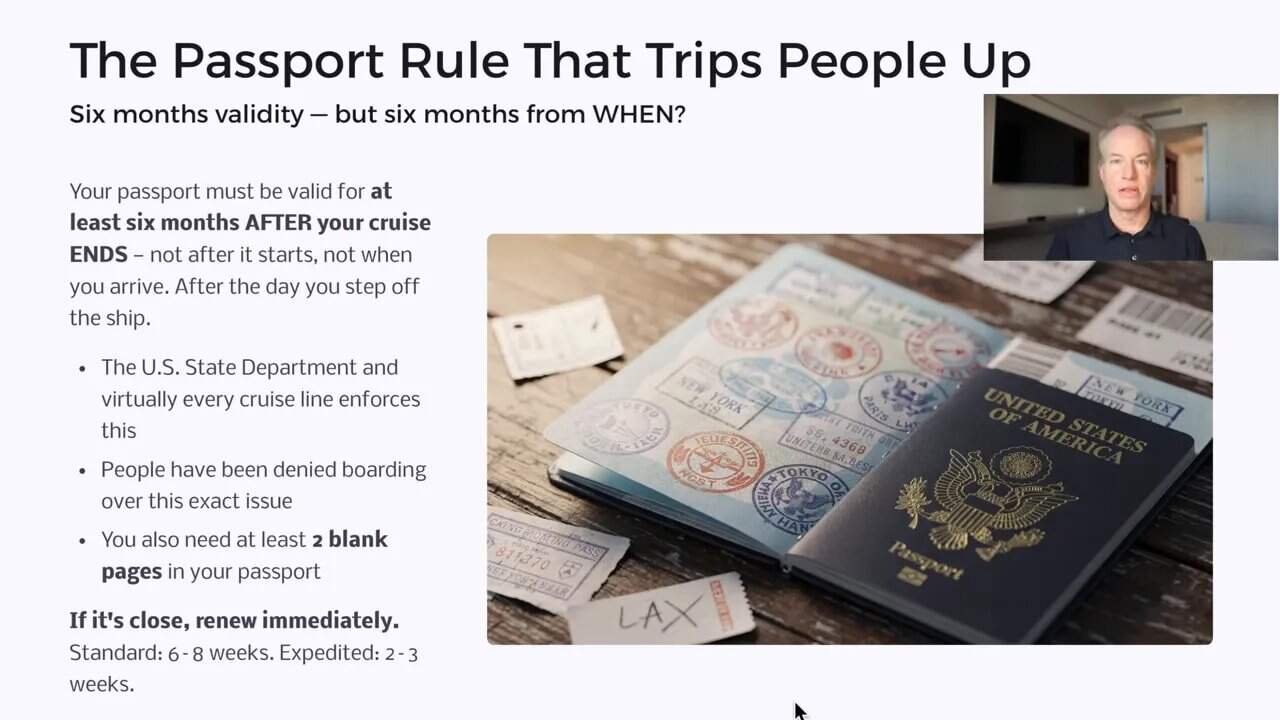
2) Use the passport 6-month rule correctly (it is based on when your trip ENDS)
This is where most travelers get tripped up. Rules vary by country, but if you want the safest, no-worries approach, we recommend making sure your passport has at least six months of validity after your return date.
That timing matters. You are traveling through multiple countries, and you want the passport validity window to cover you for the end of your trip.
Also make sure you have a couple of blank pages available. If you need renewal, it takes time and in a rush it can get expensive. Expedited renewal is possible even a couple weeks out, but expect more stress and more cost.
A practical tip: make color copies of your passport and save them to your phone. We typically keep our passport in the safe on the ship, but having a copy accessible is a smart backup if you ever need it.
3) Confirm visas and travel authorizations (and avoid sketchy visa websites)
If you are doing most European river cruises, many travelers are fine with what is currently in place, such as a 90-day visa allowance in common scenarios. However, these requirements change frequently.
There is also the possibility of later this year needing to apply online for certain Europe travel authorizations (similar to the one currently in effect in the UK). Cruise lines and travel advisors will usually alert you, but it is still smart to stay aware. These are typically easy to find online, as long as you use the official, authorized websites.
Here is what we strongly recommend:
- Be careful with websites advertising visas (especially anything that sounds like “ETIS” or similar).
- Third-party sites can charge more and sometimes do not make it clear where your payment details are going.
- Make sure you are using the authorized site for that country, not a reseller.
If you are cruising somewhere more “exotic” for river cruising, like Egypt, the Mekong, or parts of Africa, you may have additional requirements. In those cases, your river cruise company is usually very specific, so follow their instructions closely.
4) Get travel insurance (and understand what you actually need)
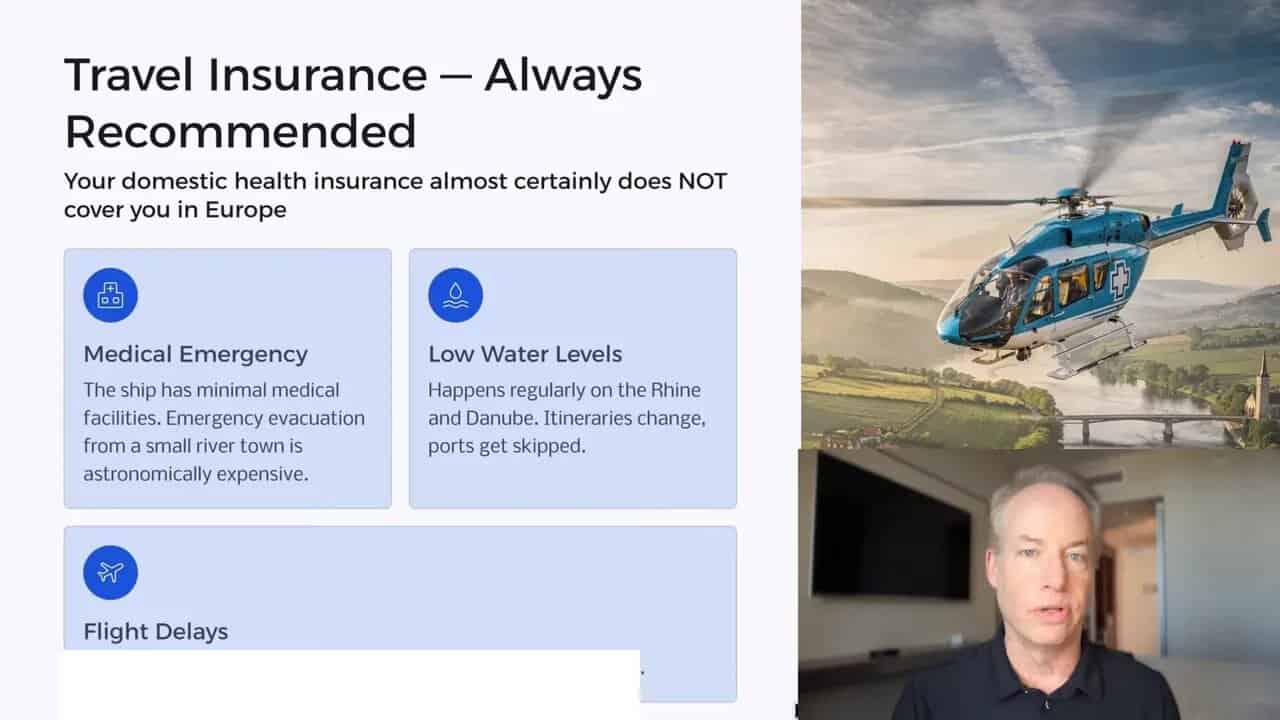
Travel insurance is not always required, but we recommend it because it can cover a lot of scenarios, and your existing health insurance may not cover you internationally in places like Europe, Asia, or Africa.
Beyond health coverage, consider whether you want protection for:
- Cancellations and trip interruption
- Flight delays and missed connections
- Evacuation
- Medical emergencies, illness and injuries
- Life reasons that force cancellation, including getting deposits or most payments back
Many people ask whether they will get a full refund. It is usually not 100 percent, but it can be up to around 80 percent depending on the policy and circumstances.
We personally use Allianz Travel Protection through Cruise Planners, but you can choose whoever you feel comfortable with. Your cruise line will also offer insurance. Just understand a key difference:
- Cruise line insurance is often tied to the cruise itself (and will not cover flights, hotels or other non-refundable costs of your trip.
- Third-party insurance is usually better if you plan to go before or after the cruise, or if you want coverage that matches how you actually travel.
5) Book flights strategically (and do not get stuck after paying a non-refundable deposit)
Flights are a big deal because you have to get there. International schedules typically begin releasing around 11 months in advance, so that is often when you will see the best availability.
Some pricing is best earlier. Sometimes it can be better at six months or even four months out, but you cannot guarantee that. If you can find a good schedule at a fair price, booking sooner often reduces stress later.
If you are booking last minute, check flight availability before you put down a cruise deposit, especially if the deposit is non-refundable. You do not want the cruise booked, the money paid, and then discover there is no reasonable way to get there (or you are stuck with two connections each way).
When “Air Plus” or cruise-line air makes sense
Some river cruise companies have air departments and their pricing can be reasonable. The biggest win is logistics. They often include transfers from the airport to the ship or hotel, making the journey smoother.
The tradeoff is cost and control. It may cost a bit more than booking yourself, and you may have less flexibility. Still, if they offer better one-on-one help versus assigning flights, it can be worth considering. Cruise lines often market this as Air Plus or a similar option.
Using points? Book flights yourself
If you want to use travel points, you usually need to book flights on your own.
A good approach is:
- Use Google Flights to search flights from your closest major airport to your cruise starting city, then search flights back from the cruise ending city.
- Check for open-jaw routings (you fly into City A and fly home from City B) by searching Multi-City instead of Round Trip.
- Review flight times and how easy the connections are. Allow enough time for connections, especially if you have to clear immigration.
If you want a starting point for point options, PointsYeah can help you search what may be available.
6) Understand open-jaw flights and which major airports usually matter
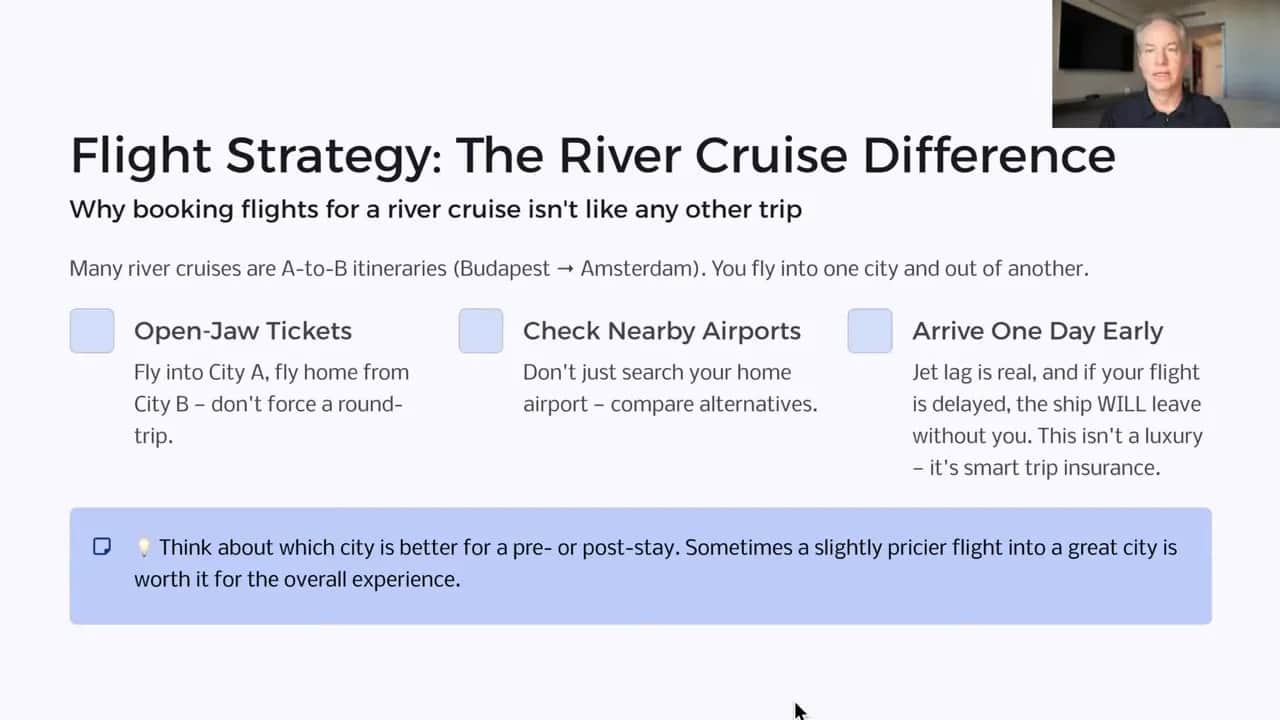
Most river cruises are open jaw, meaning you fly into one city and fly home from another.
Not always, but often. For example:
- On the Rhine, you might start in Amsterdam and end in Basel. From Basel, the international gateway is Zurich.
- For the Danube, you might start in Budapest and end in Germany, transferring to Munich (sometimes Frankfurt).
Knowing the closest major airport to each end of your cruise helps you find practical routes and reduces the chance you book flights that are unnecessarily difficult.
7) Arrive at least one day early (unless your cruise point is overnighting)
One of the best safety habits you can build is arriving at least one day early. We do not recommend showing up the morning of departure.
Could it work? Sure. There are exceptions. For example, we once traveled on Viking where the ship was overnighting at the departure point. That meant even if flights landed late, we had a cushion.
But treat “arriving late and still making it” as an exception, not your plan.
8) Use pre-cruise and post-cruise time to turn the trip into a destination vacation
River cruises are a long-haul trip, so take advantage of it. If you can, add a few days at the beginning and end.
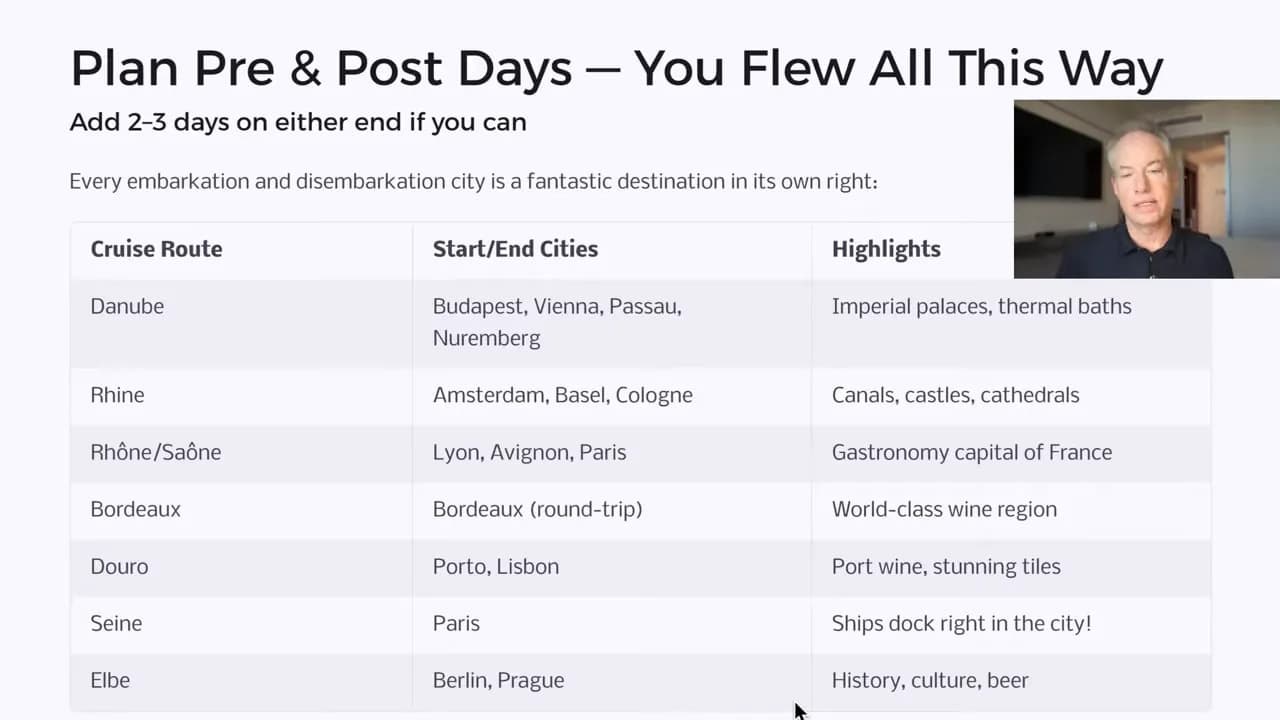
Start and end cities are destinations in their own right. Examples mentioned include:
- If you are on the Danube, spend time in cities like Budapest, Vienna, Nuremberg, or Prague.
- For the end or start of certain routes, Munich is a common major city add-on.
- For France river cruising, cities like Lyon and Paris are popular options.
- For Rhine routes, Amsterdam and Basel can pair beautifully with nearby stops.
Many cruise lines offer pre and post packages. They are usually convenient (hotel, sometimes an on-site representative, and sometimes a walking tour), but you usually pay a premium.
The good news: in Europe it is often easy to do it yourself. Train rides can be as short as one, two, or three hours. In some cases, a short flight can make a major expansion simple. If your dream stop is a place like Barcelona or Lisbon, this is how travelers often make it happen, even if the cruise route is not directly there.
Brainstorm faster with AI (but be specific)
If you want to use AI to plan what you can do in those extra days, here is a practical approach:
- Take a photo or screenshot of your idea
- Describe your preferences (food, history, walkable cities, what to avoid)
- Ask what is within a reasonable train ride range (for example, “within two to three hours”)
Better prompts create better outputs. Avoid vague requests like “I want a few days before the cruise.” Add details about what you both like, and you will usually get stronger suggestions, including “hidden gems.”
9) Included vs optional excursions: how to decide without overplanning
One of the biggest values of river cruising is that excursions are often included.
Most sailings have at least a couple of choices at each port: a classic option and a more active option. If the cruise has included excursions, we recommend you start there because they are “already yours.”
Many river cruise travelers find they rarely feel the need to book optional excursions. In fact, there are people (including us on some trips) who have never done a single optional and still felt fully satisfied.
Here is the key difference versus ocean cruising: river ships are smaller, typically carrying around 150 to 200 passengers rather than thousands. That means you do not usually need to panic book the moment everything is released.
Still, on certain stops where a full day port is involved, there may be optional add-ons. If you want more flexibility, choose from what is available, then decide later what fits your energy level.
Self-tour on port days (and don’t be afraid of walking off the ship)
Most of the time, river cruise ships dock right in the center, meaning you can simply walk off and explore. If docking is busy and not perfectly central, shuttle service is often provided.
Some ships designed for more active travelers even offer complimentary bicycles. Regardless of the ship, you can usually create your own perfect day with:
- Walkable neighborhoods
- Food and local shops
- Viewpoints and short “get there and back” routes
- Taking time to relax between planned activities
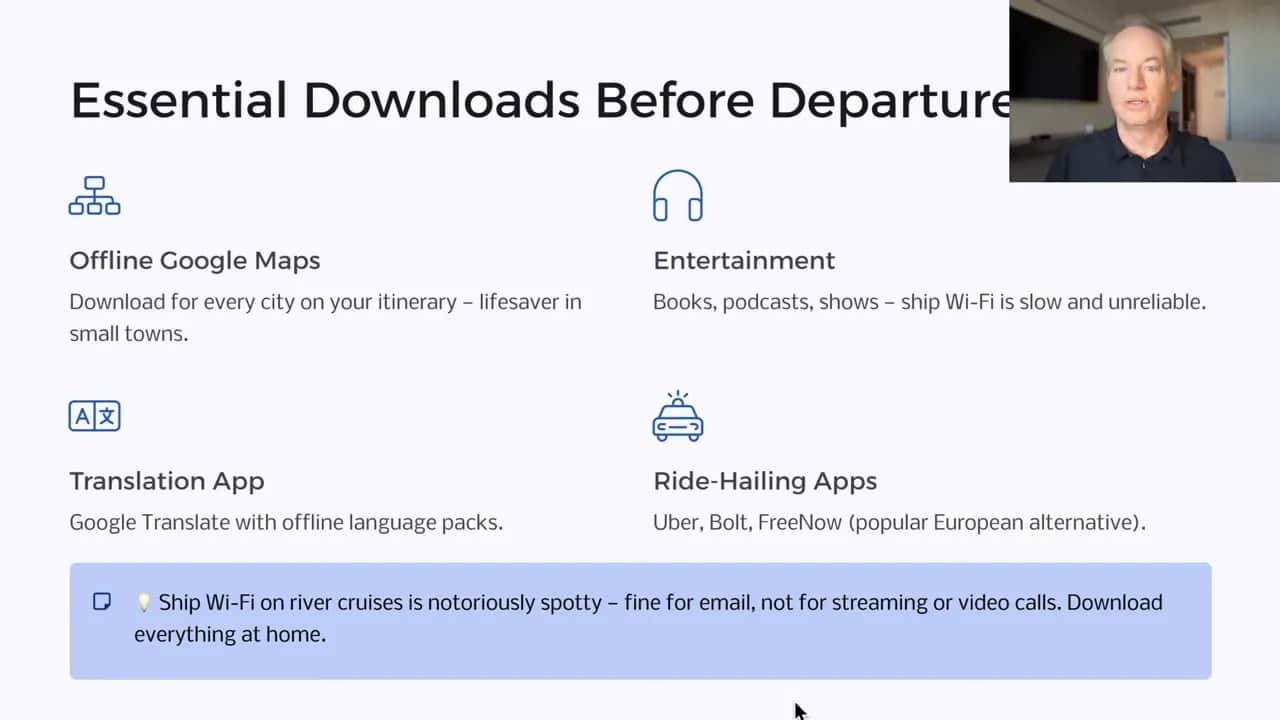
10) Download the cruise line app and offline maps before you depart
Most river cruise lines have an app. Download it before you leave.
Once you log in, you can often find:
- Your cruise information
- How to select excursions
- The daily itinerary while you are onboard
- Sometimes, even check-in options
Also download maps using Google Maps for every city on your itinerary. Connections can be unpredictable. Having offline navigation reduces stress, especially during busy days.
For entertainment, if you want to be safe about connectivity, download Netflix content, podcasts, Kindle content, or any shows you want to enjoy. Wi-Fi is included on most cruise lines, but high data streaming may be discouraged.
Ride-hailing apps: useful in cities where getting back matters
If you plan to use ride-hailing, download relevant apps in advance (and set up your means of payment). Common options in Europe include:
- Uber
- Bolt
- Free Now
In some places, ride-hailing becomes the simplest way to navigate when you want to be independent but still need an easy return route to the ship.
11) Set up connectivity with an eSIM (or configure your carrier before you go)
Connectivity can be handled two ways:
- Check your carrier and activate international data passes if needed (for example, T-Mobile may include international data).
- Use an eSIM, which is especially convenient if you are visiting multiple countries.
If you use an eSIM, you usually need an unlocked phone. We personally use one from saily.com. The benefit is that you can install once, then choose the cities, countries, or regions you need.
If you do not travel frequently, it may be easier to stick with your carrier. The main point is to decide and set it up before you go.
12) Money basics: you usually do not need to exchange currency before you travel
Many travelers worry about currency exchange. We do not think there is a need to bring a lot of exchanged cash before you go.
In many places, card payments are common, and you can use tap-to-pay or credit cards. Even when we travel for a month, we have sometimes not needed cash at all.
That said, there will be times you want some cash. It is also smart to keep in mind tipping culture. Even if gratuities are included with your river cruise, it can be nice to tip local tour guides during walking tours or experiences.
Credit card fees matter. Check whether your credit card charges foreign transaction fees. If it does, you can lose a meaningful percentage on every charge.
ATM conversion and card conversion: always say no
When you use an ATM, you might see an option asking whether you want the ATM to convert the amount into dollars. The advice is simple: say no.
The reasoning is that the ATM conversion typically adds a markup designed to make money off the exchange rate. Let your bank and credit card company convert it based on their rate.
The same idea applies at stores. If the card terminal asks whether you want conversion to USD, also say no and let your bank handle it. That approach often avoids paying the extra percentage.
13) Add walking tours and food tours (they are easy wins)
One of the best ways to get grounded quickly in a new city is a free walking tour. Search “free walking tour” plus the city name (for example, Amsterdam). You usually tip at the end based on value.
Another standout: food tours. They combine local culture, walking, and great food, and they are one of the easiest “high reward” activities for travelers who want a deeper feel for a place.
To find reliable operators, consider platforms like GetYourGuide and Viator since you can review hundreds of reviews and book with more confidence.
And do not wait until the last minute for key attractions. Plan ahead so you are not disappointed.
14) Airport transfers and how to avoid “where is the ship?” stress
How you get from the airport to your ship (and back) depends on how you booked your flights.
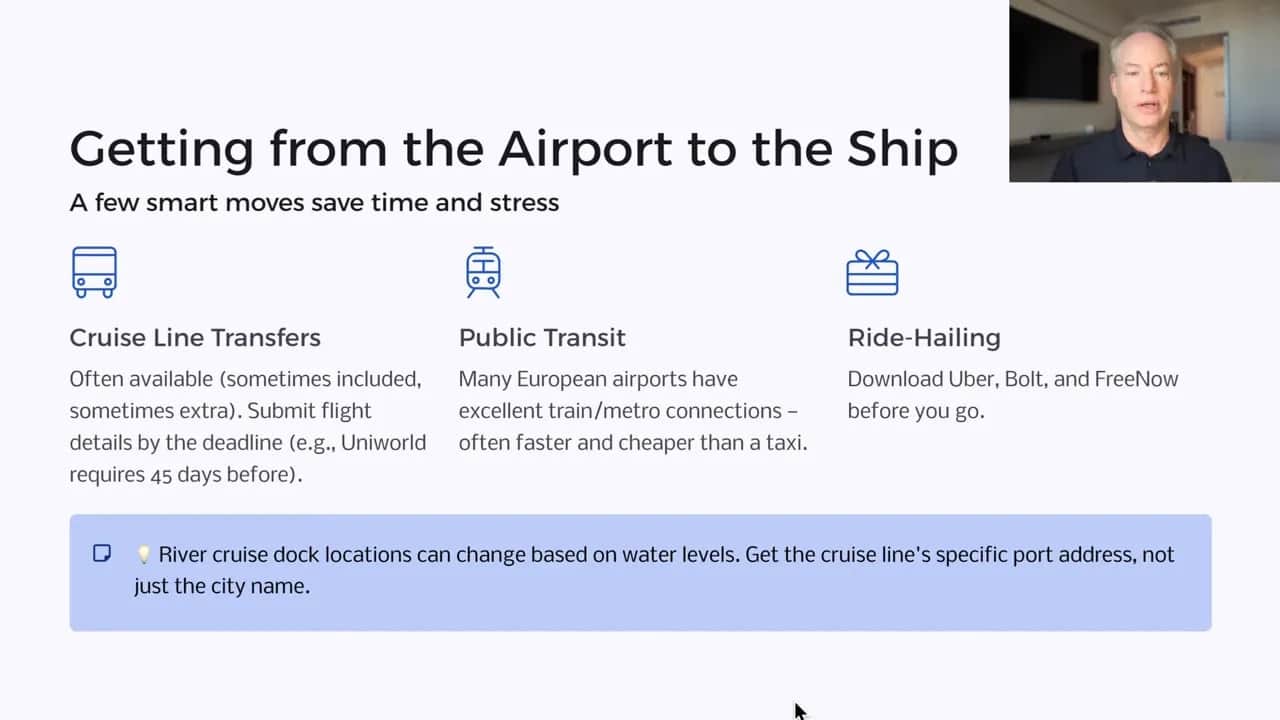
If you booked flights through the cruise line, transfers are usually included. If not, you can typically purchase transfers from the cruise line, or use public transportation. Train travel is often doable, and ride-hailing can work well too.
Either way, the important thing is this: know your route for:
- Airport to ship
- Airport to hotel (if you are doing pre-cruise nights)
- Ship back to airport at the end
Also, know where the cruise ship is docked. Sometimes dock locations can be hard to predict in advance, especially during busy seasons or events. Cruise companies typically don’t get their docking location from the local port authorities until three days prior to departure so look for an email from them with the updated location.
Most river cruise companies provide a phone number for the ship. If you are ever unsure, call. We once did a Christmas market cruise and had multiple Viking ships around. Knowing exactly where we were and getting the right ride to the correct dock made everything smooth.
15) Pack for small cabins and active days (and plan your outfits around comfort)
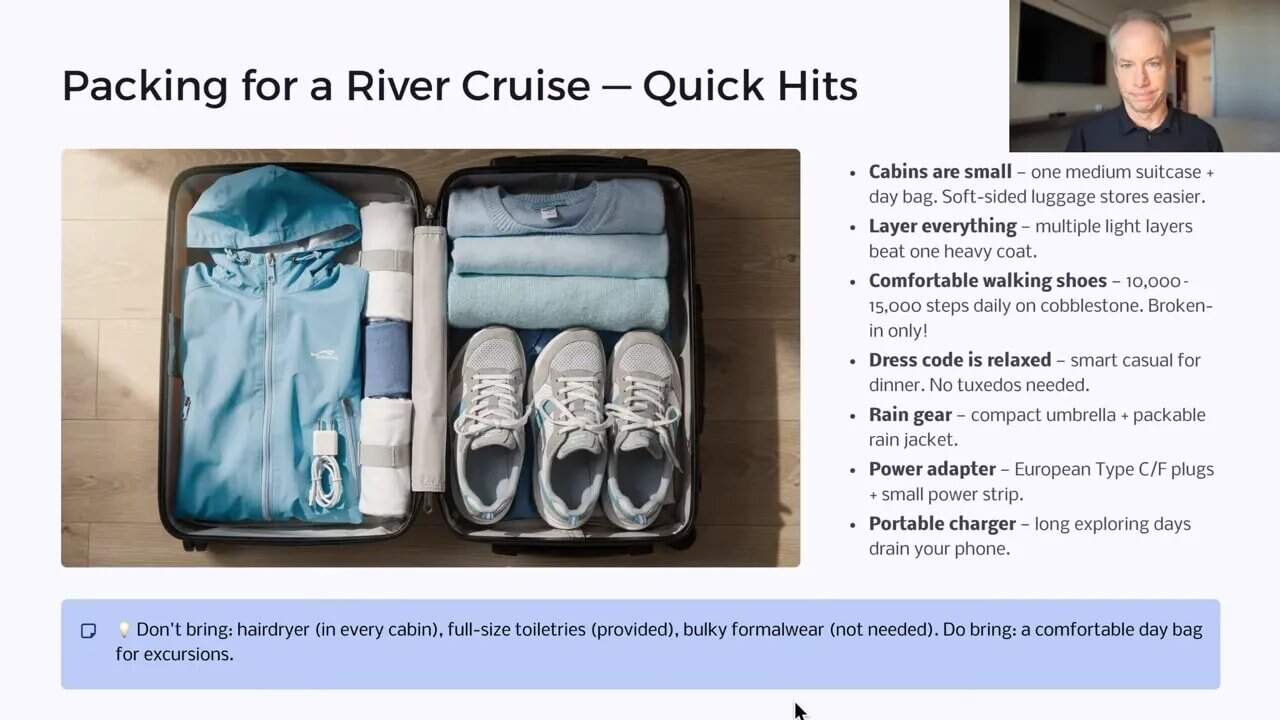
River cruise cabins are not typically huge. You also do not want to bring multiple 70-pound suitcases per person. The crew is often handling luggage logistics, too.
A practical packing strategy is:
- One medium suitcase
- One backpack or day bag
Dressing is usually not “dressy.” Think comfortable, smart casual, or country-club casual. You generally do not need tuxes or suits.
What you do need:
- Layers
- Comfortable shoes for lots of walking
- A compact umbrella and a light rain jacket for unpredictable weather
- A power adapter for European outlets or wherever you are traveling
- A portable charger so your phone stays ready for photos
Many river cruisers also recommend keeping your packing lighter than you normally would. One traveler approach we love is being shocked at how much fits into carry-ons, even if you do not use carry-ons for your own travel style.
Dietary needs: contact the cruise line before boarding
If you have dietary restrictions or needs, contact the cruise line in advance and ask about their policies. Some lines want you to meet the chef and culinary team on board, while others ask you to fill out a form. Either way, it is best to handle it before you arrive.
Insider tips from experienced river cruisers (small choices that add up)
A river cruise schedule can be busy. Even when you have included excursions, you do not have to do everything at full intensity every day.
You can often follow a pattern like:
- Morning excursion
- Lunch on the ship
- Break or nap
- Optional time later that day to explore on your own
Also take advantage of overnight stays. Getting off the ship after dinner and taking a walk in the area can be a highlight in itself.
Book your next cruise onboard if there are incentives
If you loved the experience, check whether there are onboard incentives to book your next one. Sometimes the incentive can be applied even to your current travel advisor, who can add savings or perks and upgrades.
And yes: rafting and “side-by-side” docks happen
If you book a balcony, one reality to be aware of is that in peak season ships can dock very close to each other. They call this “rafting” or docking side-by-side. That can mean you are almost looking into another cabin from your drapes. Sometimes you walk through the lobby of one ship to get to yours.
It is part of river cruising. The good news is you always have a sundeck. Spending time up on top is a favorite for many travelers, especially since the view is still great from the upper deck.
Your post-booking timeline: what to do immediately, months out, and weeks before
After booking, you do not need to do everything in one day. Spread the tasks out so it stays manageable and enjoyable.
Immediately after booking:
- Take care of confirmation details (name, ship, dates, perks, special requests)
- Access your booking through the cruise line’s guest portal and enter your passport information and emergency contacts
- Set calendar alerts for final payment
About 6 to 11 months out:
- Start your big research and logistics planning
- Work on passport validity and any visa-related tasks you need to handle early
- Begin planning flights and routing
About 2 to 3 months out:
- Select excursions
- Book hotel and activities for pre and post cruise time
- Do not wait until the last minute for key attractions
About a week before:
- Do your final checks
- Complete online check-in
- Download everything you need (apps, offline maps, backups)
- Charge devices and test how you will use them
FAQ
How far in advance should I book flights for a river cruise?
Schedules often begin releasing about 11 months in advance for international flights. If you can find a good schedule at a good price around that time, it is a strong strategy. Sometimes better pricing appears closer to six or four months out, but it is not guaranteed.
Is the passport 6-month rule based on the cruise start or the cruise end date?
Use the cruise end date. The safest approach is to have six months validity from when your cruise ends, not from when it starts.
Do I need to exchange currency before I go?
Usually, no. Many places rely heavily on tap-to-pay and credit cards. It can still be smart to have some cash for small purchases and tipping, but you can often get currency easily once you arrive if you truly need it.
Should I buy travel insurance from the cruise line?
You can, but we often recommend third-party insurance because cruise-line coverage may be limited to the cruise itself. Third-party policies are often better if you plan to stay before or after the sailing and want broader protection.
Are excursions something I need to book immediately?
Usually not as aggressively as on ocean cruises. River ships are smaller, often around 150 to 200 passengers, so you typically do not need to panic-book the day schedules release. Still, you should plan ahead for included options and decide later about optional excursions based on your pace.
Final thought: your river cruise starts after booking
Once you confirm your documents, plan your flights intelligently, set up connectivity, and pack with comfort in mind, the rest becomes the fun part.
River cruises really are special experiences. If you want to refine the plan further, consider getting personalized guidance for your next river or ocean cruise adventure.
Book with Us!
Digital Roamads has partnered with Cruise Planners®, one of the largest cruise travel agencies in the industry, so that we can offer you the best deals, extra amenities and private promotions to make your travel dreams a reality.
- Expert Guidance: We’ve taken more than fifty cruises on all the major lines.
- Exclusive Offers: We can provide access to special onboard credits and discounts.
- Personalized Service: We tailor your booking experience to your needs and preferences.
Request a free quotation today on your next cruise vacation!
Need some ideas first? Visit our Cruise Planners website for inspiration and to browse shore excursions.
